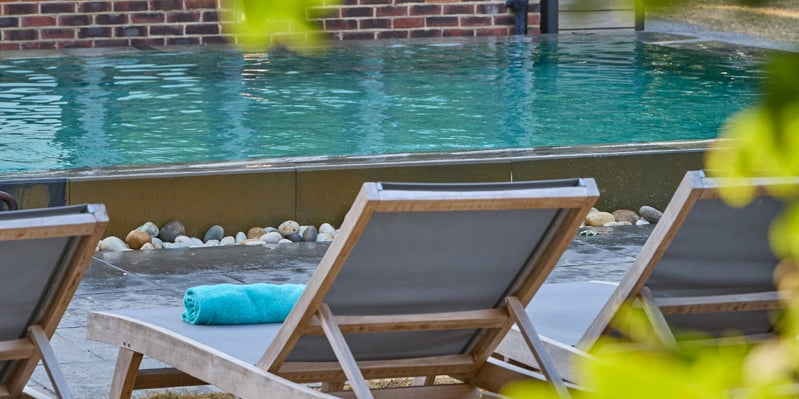
Sussex has a remarkable number of gardens to visit, helped by three very different landscapes packed close together, from the wooded Weald and the chalk of the Downs to the coastline that's mild enough for exotic species to grow.
Staying at Ockenden Manor, Bailiffscourt or The Spread Eagle puts you within easy reach of most of them. Here's our guide to the ones worth building a day around, arranged by which of our three hotels gets you there quickest.

From Ockenden Manor
Ockenden Manor sits in Cuckfield, in the heart of the Sussex Weald, an area with a rich horticultural heritage. The following gardens are part of the reason it's such a popular destination to visit.

Great Dixter, Northiam
Great Dixter was the childhood home of Christopher Lloyd, who spent almost his whole life there. He inherited the house from his parents, Nathaniel and Daisy Lloyd, who had bought the derelict medieval manor in 1910 and brought in Edwin Lutyens to rebuild it.
Lloyd changed the gardens right up until he died in 2006, most controversially in 1993 when he ripped out Lutyens' own rose garden and replaced it with the jungly Exotic Garden that's still there today.
His head gardener, Fergus Garrett, still runs the place, and the famous Long Border still gets replanted several times a season. It's open from April to October, Tuesday to Sunday, and it rewards more than one visit a year if you can manage it.
Sissinghurst Castle Garden, Cranbrook
Just over the county line into Kent, but close enough to Ockenden Manor for an easy visit. Vita Sackville-West and her husband Harold Nicolson bought the ruined Elizabethan estate in 1930 and built the garden around its Tudor tower and brick walls, dividing it into a series of enclosed "rooms" that each hold their own colour or mood.
The White Garden, planted almost entirely in white and silver, is the one everybody photographs, but the Cottage Garden and the Rose Garden are just as worth the walk. This National Trust garden is open daily year-round, aside from Christmas Eve and Christmas Day, with hours shifting seasonally.

Leonardslee Lakes & Gardens, Horsham
Sir Edmund Loder bought the estate in 1889 and spent the next three decades filling a steep Wealden valley with rhododendrons, several of which he crossbred himself, hence the Loderi hybrids that still carry his name.
He also imported a colony of wallabies, which are still there, and one of the estate's most distinctive attractions. The 240 acres run around seven man-made lakes originally dug to power the local iron industry, and the rock garden near the house, built from natural stone and a Victorian artificial material called Pulhamite, dates from 1890.
May is peak rhododendron season, but the autumn colour is just as good a reason to go. The gardens are open daily, year-round, except Christmas Day.

Gravetye Manor, East Grinstead
Gravetye is a hotel rather than a public garden, but it's worth knowing about because guests from any of our properties can book lunch there and take a tour of the grounds.
William Robinson bought the Elizabethan manor in 1885 with the proceeds of his gardening books. His book The Wild Garden was one of the inspirations for the naturalistic planting style that's now everywhere, and the walled kitchen garden he built in 1898 still supplies the hotel's kitchen.
Head gardener Tom Coward, previously at Great Dixter, has kept the spirit of the place while updating the planting for a new generation. Garden tours run on Mondays, Wednesdays and Fridays from April to October and need to be booked alongside a lunch reservation.
Nymans, Handcross
The Messel family arrived at Nymans from Germany in 1890 and quickly became one of the most important plant-collecting dynasties in the country, sponsoring expeditions abroad and bringing the results back home.
Ludwig Messel and his son Leonard, working with head gardeners James and Harold Comber, produced hybrids that are still grown today, including the magnolia and camellia that carry the Messel name.
A fire gutted the house in 1947, and post-war building restrictions meant it was never fully rebuilt. What's left is an atmospheric ruin at the heart of the garden. The National Trust recently opened a new "Garden in the Ruins" within the old Great Hall, designed as a tribute to Oliver Messel, the family's celebrated stage designer.
The garden is open daily, with no need to book, and last admission is half an hour before closing.
Sheffield Park and Garden, Uckfield
Sheffield Park started life in the 18th century under Capability Brown, with Humphry Repton adding to the design shortly after. But the garden most visitors see today is the work of Arthur Gilstrap Soames, who owned the estate in the early 20th century and planted it specifically to put on a show every autumn.
His plantings of Nyssa sylvatica, the tupelo tree, form the largest single-site collection in the country, and they turn earlier and more dramatically than most. Four lakes, joined by cascades, run through the middle of it all and add to the impressive views.
Late October is the moment to aim for, though the rhododendrons and waterlilies make a strong case for a spring or summer visit too. The garden is open daily, except on Christmas Eve and Christmas Day.

From Bailiffscourt & The Spread Eagle
Bailiffscourt sits near Climping, close to Arundel and the coast, while The Spread Eagle is in Midhurst, further into the South Downs.
Between them, they put you within striking distance of a unique set of gardens. Here's the best of them.

Arundel Castle Gardens, Arundel
April is the month to time a visit around, when the Tulip Festival fills the castle grounds with well over 100,000 tulips across more than a hundred varieties.
Head gardener Martin Duncan plants the display fresh every year across the Collector Earl's Garden, the grass labyrinth and the steep earthwork banks below the castle walls, and the show changes noticeably from week to week as different varieties come into bloom.
Beyond tulip season, the 40 acres of grounds include a stumpery, a wildflower garden and views over the River Arun that are worth the climb on their own.
The gardens are open daily from April to November. Closed Mondays, except for bank holidays and throughout August.

Woolbeding Gardens, Midhurst
Woolbeding is a hidden gem; there's no public car park, and visitors arrive from Midhurst by a National Trust minibus.
Simon Sainsbury and his partner, Stewart Grimshaw, took on the lease in 1972 and spent over three decades building a garden of contrasts, from Lanning Roper's formal garden rooms around the house to the more theatrical Long Walk added later by Julian and Isabel Bannerman, complete with a ruined abbey, a Chinese bridge and a folly named for a champion tulip tree lost in the 1987 storm.
Numbers are capped, so it never feels crowded, and it's only open on selected days between spring and early autumn; advance booking is essential.

West Dean Gardens, Chichester
West Dean's showpiece is a 300-foot Edwardian pergola designed in 1911 by Harold Peto, who also worked on Iford Manor in Wiltshire.
Edward James, later a major patron of the Surrealists, including Salvador Dalí, helped lay the pergola's foundation stone aged five and inherited the estate in 1912.
The walled kitchen garden behind it holds thirteen working Victorian glasshouses and one of the best fruit collections in the county. The gardens are open daily throughout the year, with shorter hours from November to February.
Uppark, South Harting
Uppark's garden is Reptonian, but the house is the real story here. A fire broke out during a re-roofing job in August 1989 and gutted the upper floors.
The National Trust spent six years and around £20 million putting it back together, training a generation of conservators. The result is a house that looks untouched by the fire, set high on the Downs with views that reach the coast.
H.G. Wells (who also stayed at The Spread Eagle) lived here as a boy, when his mother was the housekeeper, and later wrote that the place left a lasting mark on him. The garden is free to visit and open Sunday to Wednesday.

Parham House Gardens, Storrington
This Elizabethan house has only had three owners since its foundation stone was laid in 1577, which says something about how little Parham has changed. The Pearson family bought it in 1922 and spent forty years filling it with paintings, furniture and needlework before opening it to the public in 1948.
The four-acre walled garden dates to the 18th century and still grows vegetables, cut flowers and fruit against its original brick walls, alongside a 1920s greenhouse and a Wendy House that's become something of a fixture on its own.
The wider grounds include a lake, a maze and 875 acres of deer park below the South Downs. The gardens are open on Wednesdays, Thursdays, Fridays, Sundays and bank holidays from Easter to mid-October.
Denmans Garden, near Arundel
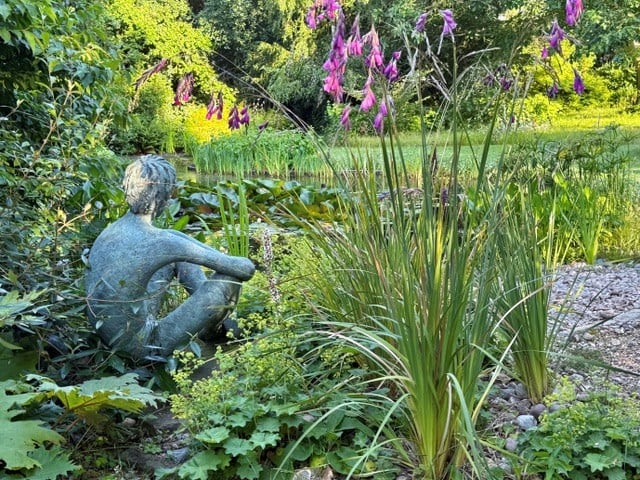
Denmans has an unexpected link to Bailiffscourt; its creator, Joyce Robinson, grew up in Climping on her family's farm at Bailiffscourt before she and her husband converted a derelict market garden at Fontwell into one of the most influential gardens in the country.
A pioneer in gravel gardening, in 1970, once she'd stepped back from farming, she began experimenting with gravel and developed extensive, diverse gravel gardens in and two dry riverbeds which were meant to evoke the winterbourne streams of the South Downs.
The landscape designer John Brookes MBE discovered the garden through the National Garden Scheme in the early 1970s. In 1980 he renovated the old stable block as his design studio and home, and spent the next four decades layering his own bold structure over Robinson's looser planting, adding sculpture, water features, and his own gravel garden in front of the old stableblock he'd renovated.
It's a small, tranquil garden, at four acres, but it's taught more professional designers than almost anywhere else in Sussex. Denmans is open daily, though it closes on Sundays through January and February.
Munstead Wood, Godalming
Just over the Surrey border, but too significant to leave out. This was Gertrude Jekyll's own home and garden from the 1890s until she died in 1932, and the place where she worked out the planting theories that went on to shape more than 400 gardens across Britain, Europe and America.
The house was designed for her by a young Edwin Lutyens, in what became the first of their many collaborations. The National Trust only bought the property in 2023, and access is still limited while restoration continues, so check ahead before planning a visit.
Access is currently limited to pre-booked "behind the scenes" guided tours on weekdays and some Saturdays running through July, August and September.
Stansted Park, Rowland's Castle
Stansted's walled garden dates back to the 18th century. Tucked inside a 1,800-acre park, the current house is Edwardian, rebuilt after a fire in 1900, and the estate has been run since 1983 by a charitable trust set up by the 10th Earl of Bessborough.
The Gothic chapel near the garden centre was reconsecrated in 1819 with the poet John Keats among the congregation. Beyond the walled garden, there's a working farm shop and one of the longest beech avenues in England running off through the surrounding forest.
The grounds and walled garden are open year-round; the house and chapel keep shorter hours, Sunday to Wednesday, from Easter to the end of September.
Ready to Visit the Best of Sussex Gardens?
You're never more than a short drive from the best of Sussex in bloom when you book a stay at one of our three hotels.
Our team can help you time your visit to the season, arrange transport and book ahead where it's needed, from Woolbeding's minibus to a lunch and garden tour at Gravetye Manor.
Check availability and plan your garden break today.